
There's a version of poker where you can't fold. Where your opponents watch every card you place in real time. Where a single bad decision four cards ago quietly ruins your entire hand and there's nothing you can do about it except sit there and watch it collapse.
That's Open Face Chinese Poker. And it just went live on Phenom Poker.

I'll be honest - when I first heard the pitch on OFC, I assumed it was one of those games that sounds interesting at a Vegas pool and then never gets played again. A home game novelty. Something people talk about on poker Twitter and forget.
Then I actually played it. Then I fouled my board spectacularly in front of four people. Then I played it for three more hours and genuinely didn't notice the time passing.
This game is something.
Start From The Beginning - What Is Chinese Poker?
Classic Chinese Poker is the ancestor. Each player gets all 13 cards at once, face down, and arranges them into three separate hands: a 3-card "front," a 5-card "middle," and a 5-card "back." The hands must rank in order - back strongest, middle second, front weakest. Break that rule and you foul. Fouling means you lose everything automatically, no matter how strong two of your three hands are.
That's the framework. Simple enough on paper.
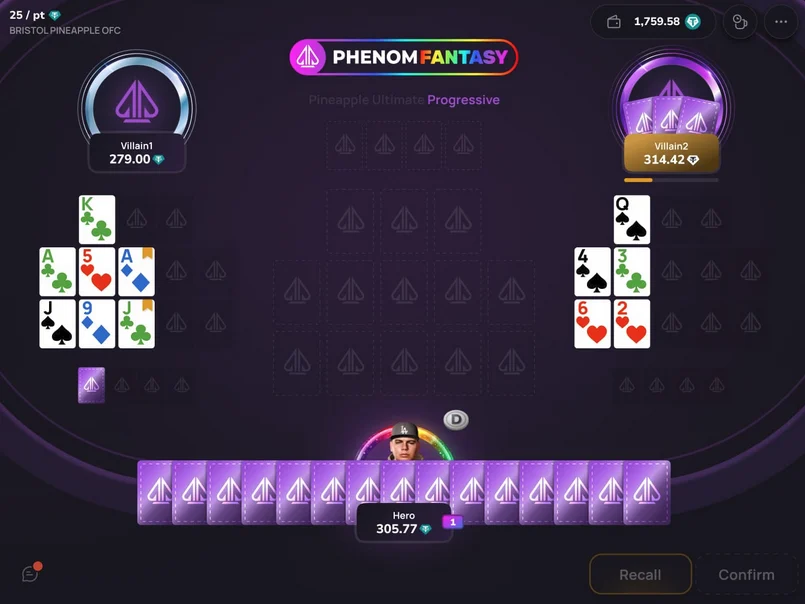
Open Face Chinese Poker is what happens when someone looked at that game and asked what it would feel like with no information advantage whatsoever. Instead of receiving all 13 cards privately, you get five to start - face up, visible to everyone - then draw one card at a time and place each one immediately. No holding it. No waiting to see the next card before deciding. You place, it stays, and your opponents are watching the whole disaster unfold.
The "open face" part means exactly what it sounds like. Your entire hand development is public. Your opponents can see that you're three cards into a flush draw on the back. They know when you're in trouble. They absolutely know when you've just locked yourself into a fouled board two streets before the end.
Pineapple OFC - the most commonly played variant - gives you three cards per drawing street instead of one, and you discard one before placing the other two. Like standard OFC, you still start with five cards face up. After that, three cards per street, discard one, place two. More decisions per turn. More ways to get it wrong. More fun.
How Scoring Works (Read This Part Twice)
OFC scoring is head-to-head. You're not playing against a pot. You're playing against each opponent individually across all three hands simultaneously.
For each of the three hands you win against an opponent, you take a point. Lose a hand, they take a point. The net matters. Win two out of three and you're up one unit. But scoop all three hands and it's not just +3 - standard OFC runs a 1-6 scoring system where a scoop adds a three-point bonus on top, making it a six-point swing in a single hand before royalties are even counted.
That number is important. Because royalties stack on top of everything, and they come up constantly.
Royalties are bonus points awarded for making strong hands in specific positions - and they trigger far more often than people expect when they first learn the game. A pair of sixes or better in the front earns bonus points. Three of a kind in the middle. A straight in the back. These aren't rare premium hands. They happen regularly, which means royalty math is part of almost every hand you play at a competent table.
Then there's Fantasyland - which is an entirely different beast. To enter Fantasyland, you need to make queens or better in your front hand without fouling. Pull that off and next round you receive all 13 cards at once, face down, like a normal person - while everyone else is still grinding cards one at a time in open face format. You sit there arranging your hand in peace while your opponents sweat every draw in public.

Staying in Fantasyland requires hitting specific thresholds: quads or better in the back, a full house or better in the middle, or trips in the front. Hit any of those and you stay. Keep going. Repeatedly. While everyone at the table develops a quiet, sustained resentment toward you.
Getting stuck against someone on a Fantasyland streak at a heads-up table is one of the more demoralizing experiences the game has produced. I'm not speaking hypothetically.
Why This Game Actually Suits Recreational Players
Hold'em in 2026 is a different animal than it was ten years ago. The solver kids exist. The training sites exist. The guy at your local casino's 1/2 game who has run 500k hands through GTO Wizard and memorized 3-bet frequencies by position exists. He's pleasant enough but he's taking your money with mathematical precision and he doesn't feel bad about it.
OFC doesn't have that problem yet. The skill ceiling is real - good players will beat bad players over time - but the game is different enough from Hold'em that the edge compression is genuine. The reads are different. The decision trees are different. Most importantly, the game is new enough on most platforms that you're not sitting down against a population of battle-hardened regulars with 50,000 OFC hands in their database.
Phenom Poker just launched OFC. The games are fresh. The player pool is still forming. That matters.
The social element is also genuinely fun in a way that online poker has ground out of most formats. Watching someone's board build, seeing them chase Fantasyland and brick on the last street, watching a scoop-with-royalties swing hit someone for a double-digit point count in a single hand - it actually has a pulse. The decisions are visible, the drama is real-time, and the variance is violent enough that anyone at the table can be up or down a big number inside an hour.
One thing I'll say for OFC: it's one of the only formats where I've watched a supposedly strong player go completely on tilt. There's something about watching your own hand collapse in public, card by card, with zero ability to fold and walk away, that gets to people. Including people who should know better.
Where to Start on Phenom
Phenom has the rules page up and the games are running now. The site is player-owned, crypto-native, and has been building out its game variety properly rather than just running NLHE with a few PLO tables and calling it a poker room.
The rest of the Phenom roster is worth knowing - Brian Rast, Dan Cates, Huck Seed, Phil Laak are all attached to the site. These aren't influencer signings. These are players.
And if you needed one final data point on whether Phenom's high-stakes ecosystem is real: Viktor "Isildur1" Blom recently deposited 13K USDT and ran it past 1.75 million at the nosebleed tables, grinding primarily 8-Game Mix with his biggest profits coming from 2-7 Triple Draw. The mixed game action on this site isn't decorative. OFC is the newest addition to a lineup that's already attracting people who take poker seriously.
Get in before the regulars figure out the game. That window doesn't stay open forever.