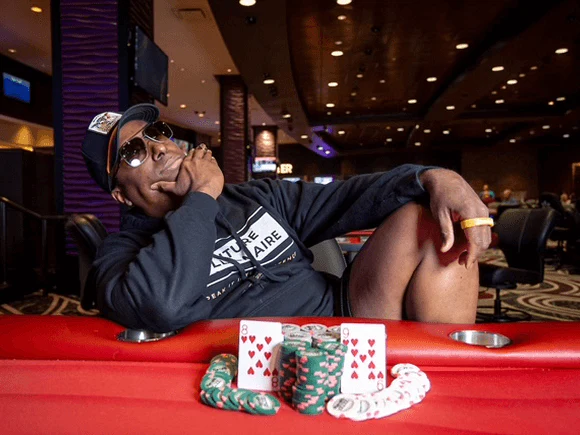

Maurice Hawkins filed for Chapter 7 bankruptcy in the Southern District of Florida on April 23, less than three weeks after winning his record 24th WSOP Circuit gold ring and one day after a tournament cashout in Tunica reportedly got intercepted at the cage by a garnishment order.
The petition, filed through attorney Michael A. Kaufman, lists Randy Garcia among the creditors. Garcia is the former backer who in 2019 won a $115,828 final judgment against Hawkins out of Palm Beach County. Garcia later agreed to settle for $30,000 in $2,500 monthly installments. Hawkins reportedly stopped paying after a few months.
Now everything goes back on the table. And by "the table" I mean a federal courtroom.
The filing comes in the middle of what should be the best stretch of Hawkins's career. He has $217,254 in tournament earnings already in 2026. He had $741,937 in 2025 and $853,068 in 2024. He chopped the Beau Rivage Heater $500 Triple Stack for $80,944 in January, then took down WSOPC Tunica Event #2 a week later for another $35,146. The Elgin ring win for $17,419 happened on April 6.
Hawkins ticked the box on the petition indicating his assets are worth between $500,001 and $1,000,000. He listed his liabilities as between $100,001 and $500,000. Read that twice. He is telling the court his assets exceed his debts.
That is not what bankruptcy normally looks like.
The cage is where this story actually starts
PokerNews reported that a source on-site in Tunica saw Hawkins try to collect a tournament cash and learn the money had already been frozen by a garnishment. The bankruptcy petition was filed the next day.
That sequence is the entire story. A garnishment is a court-ordered intercept that hits cashable assets — wages, bank accounts, and yes, tournament payouts in jurisdictions where card rooms comply. Once one garnishment lands successfully, more follow. Every cage Hawkins walks up to from now until the judgment clears becomes a potential repeat of the Tunica moment. Filing Chapter 7 freezes that. The automatic stay halts collection activity the moment the petition hits the docket.
A bankruptcy attorney I spoke with who works consumer Chapter 7 cases in Florida and asked not to be named put it bluntly. "When somebody with that kind of income files a 7 the day after a garnishment lands, the trustee is going to look at it. Whether the U.S. Trustee actually pursues a 707(b) dismissal or a creditor objects to discharge under 727 is another question, but the optics are not great. The fact pattern they're going to argue against him is that the petition is not about insolvency. It's about stopping the garnishment."
That's the legal version. The poker version is shorter. He didn't want the cashout taken twice.
Rogen Chhabra, the attorney who filed the garnishment with Garcia, was a guest on the PokerNews Podcast and laid out the same case in plainer terms. As Chhabra explained, the bankruptcy is a speedbump that could lead to discharge, but they have a path to fight it by showing Hawkins isn't actually bankrupt and is instead using the system to dodge accountability.
My read on what's actually going on
I'll say what most outlets won't.
I don't think Hawkins is the one who decided to file Chapter 7 last week. I think a current backer did.
Hear me out. If you're putting up money for a player who's been running this hot in 2026, you expect a return on that action. What you don't expect is to watch the cage hand the cash to a creditor from seven years ago because of a judgment that has nothing to do with you. The Tunica garnishment didn't just take Hawkins's money. It took the backer's money too. That's the kind of moment that ends staking deals very fast and forces hard conversations about how to make the legal exposure go away.
Chapter 7 makes the Garcia judgment go away if it's discharged. From a backer's standpoint, that's the only way Hawkins becomes a clean asset to invest in again.
I have no proof of who funded these recent buy-ins. Nobody will say on the record. But the timing fits a story where a new piece of money got burned at the cashier window, and the response was to clean house at the federal level. Hawkins on his own has been tolerating this judgment for years. Something changed in April.
The David Peters sidebar, because the timing is unbelievable
The Top of Poker Has a Settlement Problem
A week before the Hawkins petition hit, David Peters — almost $50 million in Hendon Mob cashes, top-tier high roller — got publicly accused by Dylan Linde of refusing to pay back nearly half of a $50,000 piece of action from a Triton event last year. Linde said Peters agreed to take a chunk of his action and then went silent on the back end.
Peters responded in a long tweet. Linde pushed back. Mike Matusow weighed in, because he always does.
Two stories in two weeks involving multi-million-dollar earners and unpaid action obligations. If guys at the very top of the game can't settle a five-figure deal without it spilling onto Twitter, the action market beneath them is in worse shape than people think. Trust is the only thing holding most staking arrangements together. It is leaking.
What this means for everybody who isn't Maurice Hawkins
If you stake other players, get the agreement in writing. Define makeup, settlement, jurisdiction, and what happens when a player won't pay. Verbal deals between friends end up in screenshots posted by attorneys.
If you get staked, treat that obligation as senior debt. Backing money is not income. It pays out only when the player wins, and the player loses more than they win.
Tournament cashes are attachable. The cashier is not your friend. The cashier is a regulated business that responds to court orders. If you have a judgment hanging over you, every cage in the country is a potential collection point.
And the most important one. Watch how players handle losses before you trust them with money. The best read on long-term reliability isn't how somebody plays a flopped set. It's how they pay back $200 they owe you when nobody's watching.
One last thing
Hawkins's petition will play out in front of a federal judge over the next several months. Garcia and Chhabra have filed an opposition track. The trustee will look at the asset disclosures. If the discharge goes through, the judgment is gone. If it doesn't, Hawkins is back at the cage trying to outrun a garnishment with a 50% holdup at every payout window.
Either way, the lesson for the rest of us is already written.
The cage remembers. The judgment remembers. The backer remembers.